At work in the ATmosphere

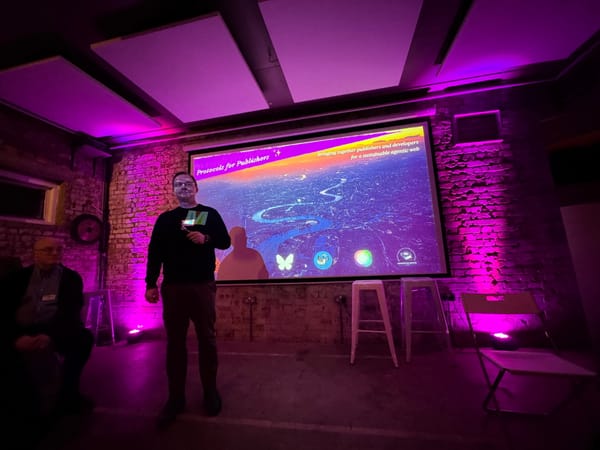
The Executive Summary for the Protocols for Publishers ✨ London Stakeholder Forum (jump to recap here) shipped last week and contained a page with 14 action points distilled out of the conversations in the room.
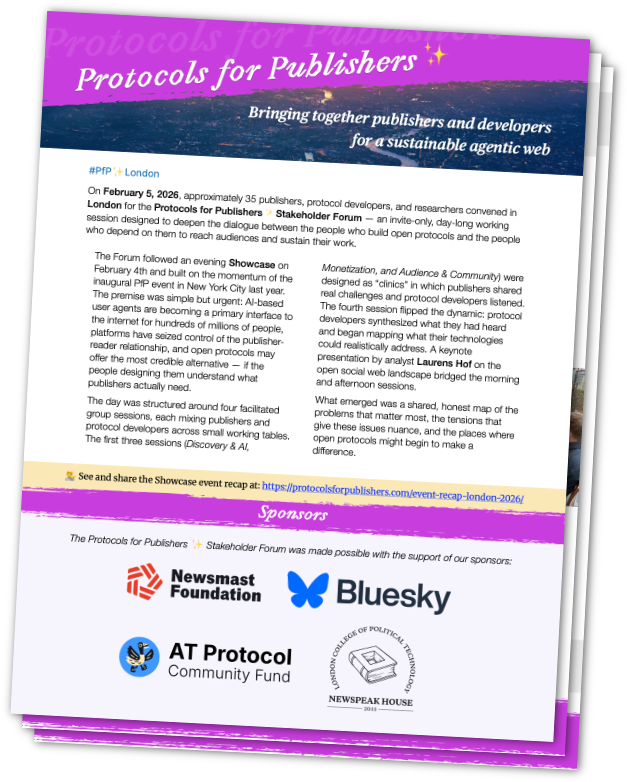
We will be discussing those action points more in the future but here are two that have already seen progress:
- Build WordPress and Drupal plugins for Standard.site An open metadata standard is only useful if publishers can adopt it without engineering effort.
- Create a “byline” field separating author identity from publication identity When journalists move between publications, their body of work should remain linked to them — without creating security or copyright risks.
Both of these items are related to standard.site, a schema for long-form publishing on AT Protocol which powers a whole ecosystem of social apps including Bluesky. Using standard.site's schema, your articles and publication metadata are stored in a standardized way on AT Protocol. This means you can take them with you to any other compatible platform without starting from scratch. Think about it like this: we could have many competing reading experiences in the spirit of Apple News, but without any single gatekeeper controlling access to your audience. Standard.site represents a path toward owning your publishing identity and audience the same way you'd own your own domain name, and it extends across an entire open ecosystem of apps!
The two action items mentioned above that came out of PfP✨ look to take advantage of the growing momentum behind standard.site. A discussion about bylines is happening on Tangled (a decentralized code hosting and collaboration platform). And Tyler Fisher, PfP✨London participant, released Wireservice: a WordPress plugin that makes it easy for publishers to publish posts to AT Proto as standard.site documents.
 Tyler Fisher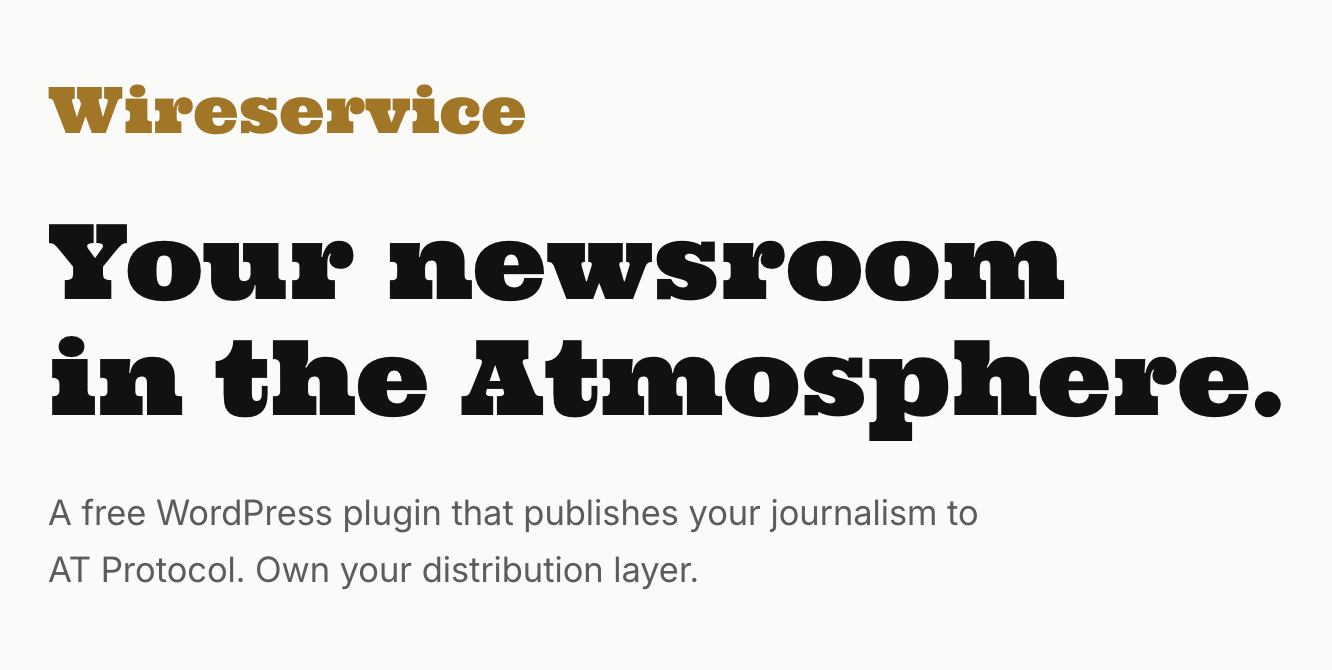
Structuring articles in this way not only prevents lock-in but can help with distribution and discovery. Not only could this be an improvement on the old RSS protocol, but this more structured approach could help journalism-friendly LLM tools to better understand articles (and possibly provide hooks for giving proper credit).
We want PfP✨ to be the meeting place where developers and publishers can surface real use cases for web publishing, leading to new capabilities on the web.
🛠️ More community at work in the ATmosphere
The Open Graph protocol (originally created by Facebook in 2010) is the reason why when you paste a link it "unfurls" into a preview of the web page with a thumbnail image, header, and description. Unfortunately it is effectively unmaintained and has not improved much. New protocols mean new capabilities, so can we make something better? Alexandre Plennevaux took a first run at much richer URL previews on atproto. His example is a user profile card that has a FOLLOW button right in the preview: https://github.com/pixeline/schema-org-atproto-profile?tab=readme-ov-file
Imagine what other actions could be added to such rich URL previews… 🤔 You could have all sorts of CTAs, and even simple mini-apps right in the timeline! More discussion on what richer unfurls could unlock on the AT Proto Community forums: https://discourse.atprotocol.community/t/ideas-on-extending-schema-org-embed-displays-for-atproto/631
The Ghost CMS has a very basic "blogroll" feature for recommending other Ghost publications and letting them know about it. For example, if you are running Ghost and added protocolsforpublishers.com to your Recommendations (which can be found in your Ghost Settings > Growth > ♥️ Recommendations section… please go ahead and do it, we'll wait 😉), then we here at PfP✨ will get a notification. Ghost uses the webmentions standard, which was an iteration of pingbacks, the bi-directional linking feature that turned the blogosphere into a densely interlinked network. Recommendations were an action point raised at PfP✨ London, and independently Boris Mann has asked the AT Proto Community how they can power recommendations for Standard.site publications: https://discourse.atprotocol.community/t/ghost-uses-webmentions-to-power-recommendations/639
New Public_'s new neighbourhood app Roundabout is built on atproto. They needed the capability to schedule posts, a feature Bluesky does not have yet. So Blaine Cook and his team at NP built it. But not just for New Public, they built it for everyone. https://leaflet.pub/p/did:plc:3vdrgzr2zybocs45yfhcr6ur/3mfuiu2yl4k2u
PfP✨ NYC participant Aram Zucker-Scharff pushed Marksky Pub, a tool for publishing static sites written in markdown to the ATmosphere. https://tangled.org/chronotope.aramzs.xyz/marksky-pub
Eurosky has released their new application to migrate AT Proto accounts to Europe. They named it EU-HAUL! 🥁👏 https://move.eurosky.tech/
Not code or an app, but if you are still trying to understand how AT Protocol is different from the Fediverse and other decentralized architectures, Bsky CTO Paul Frazee has a writeup about practical decentralization. Pullquote: "What is the purpose of protocols? To guarantee the rights of individuals and communities." https://www.pfrazee.com/blog/practical-decentralization
🗺️ Elsewhere
Since 2016, Github activity by newsrooms has dropped 80%. Newsrooms are no longer building in the open (if they are building at all). The incentives need to change, and the PfP✨ argument is that with the platform shift we are going through this is an opportunity to be proactive, and don't let technology happen to you. https://source.opennews.org/articles/journalism-lost-sharing-culture/
Netflix made a deal to bring The Ringer show The Bill Simmons Podcast and 15 other shows over from YouTube. This is in partnership with Spotify, which will continue to "broadcast" the audio versions. Three giant platforms fighting with one another. None are using RSS, so can we even call them podcasts? https://awfulannouncing.com/ringer/bill-simmons-questions-long-term-viability-youtube-podcast-platform.html
A study of people in news deserts found that many people with no local news options "turn to social media feeds, influencers and gossip" and "don’t think of themselves as being deprived of local news sources" https://localnewsinitiative.northwestern.edu/posts/2026/02/10/news-deserts-social-media-local-news-medill-survey/
How Canadian media are using AI in the newsroom: a roundup by The Tyee. https://thetyee.ca/News/2026/02/11/AI-Elephant-Newsroom/
The International Telecom Union (ITU) has gathered together 880 (at time of publication) in an AI Standards Database. You can drill down into the standards based on "Human AI Activity" or "Industry vertical".
🗓️ Upcoming Events
The first Journalism Technology London Meetup was held at Newspeak House last week. Chloe Kirton, Senior UX Designer at The Guardian, spoke at the event and wrote about it. This will be a regular meetup so subscribe to the Newspeak Luma calendar to be notified for the next one. https://luma.com/newspeak-house
March 16: Hacks/Hackers AI x Journalism Day is happening in Austin https://www.hackshackers.com/hacks-hackers-ai-x-journalism-day-in-austin-march-16/
March 18: Metagov will be hosting a seminar with Mozilla Data Collective. If you want to learn how the Data Collective allows you to share your data with AI developers, retain ownership of it and control who uses it, register here: https://luma.com/03jcpr1x
March 26-29: ATmosphereConf, the AT Protocol Community event is on in Vancouver BC 🇨🇦 (PfP✨ will be there!) See the panel: "How and Why News Organizations Should Build on the ATProtocol" https://atmosphereconf.org/
May 12: Hacks/Hackers AI x Journalism Summit 2026 https://luma.com/hh-aijournalismsummit-2026?ref=hackshackers.com