ATmosphereConf 2026

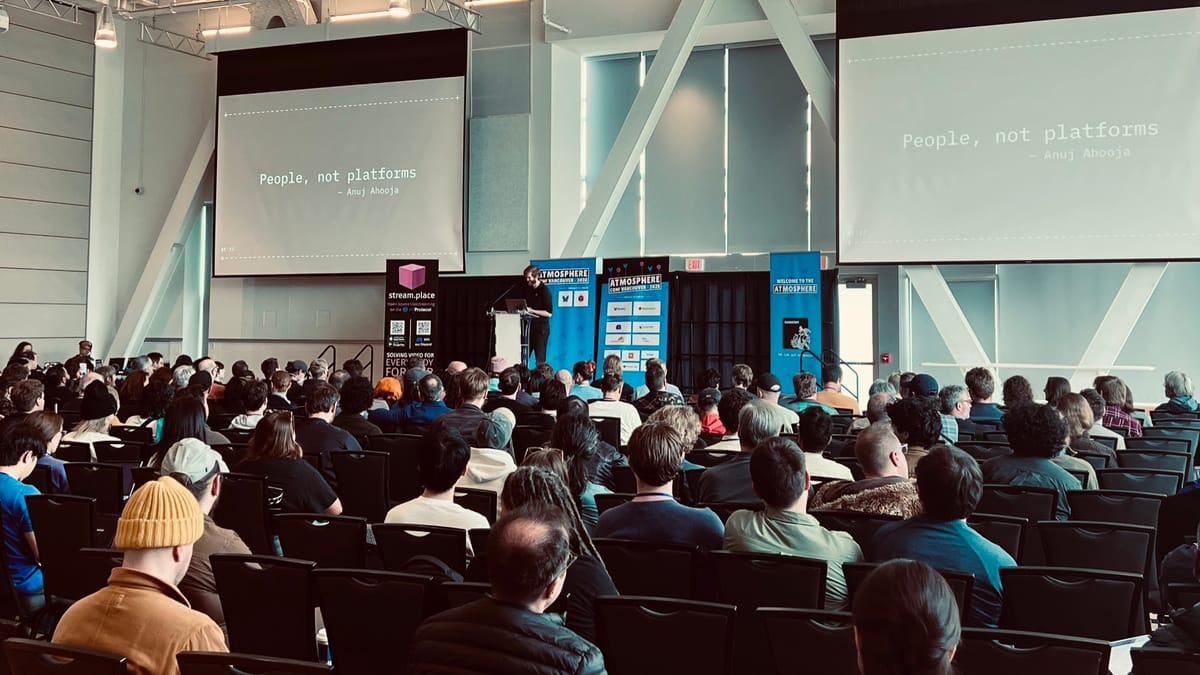
Amongst the blooming cherry blossoms and the busyness of students on reading break preparing for exams, the global AT Protocol community conference ATmosphereConf convened at the University of British Columbia campus in Vancouver BC from March 26-29. This is the second year of the conference. Although supported by Bluesky PBC, it is a community-led conference, and that is important to remember. Over 350 in-person and 557 remote attendees gathered for three tracks (and an extra unconference track), which is about twice the attendance of last year's inaugural meeting in Seattle.
Many PfP✨ community members were in attendance and Chad Kohalyk MC'd the Media and Civics track which hosted a number of talks on journalism, digital sovereignty, and public-interest infrastructure. Here are some highlights:
- The Aggregation Era burned journalism institutions to the ground. The federated era is emerging from those embers Justin Bank maps the growing news creator ecosystem
- The Economics of Sovereign Media: A Roadmap for AT Protocol Bain Capital analyst Natalie Mullins outlines the structural shifts reshaping media markets
- A discussion with news creators Panel with Ted Han, Justin Bank, and Lauren Saks
- Advocating for Digital Sovereignty: European Experiences and Global Lessons Sandra Barthel gives an update on EU policy
- Open social tech and geopolitical risk Ivan Sigal discusses networked authoritarianism and considers options and strategies for open networks
- Oaklog: Building a community calendar in the Oakland Bay Area Glenn Poppe introduces an initiative between local news and community orgs
- Journalism must create its own algorithms Ændra Rininsland talks feed generation and also shares some ideas for journalistic labellers
- How and Why News Organizations Should Build on the ATProtocol Jim Ray interviews Tyler Fisher and Ændra Rininsland on building in the ATmosphere
- Bluenotes: Community Notes for ATProto Jonathan Warden thinks through peer moderation
- Pollen: Prototyping a toolkit for journalists and researchers to restore source transparency in an AI-saturated feed Hypha and Starling Lab demo how Perceptual Hashing could be used for image provenance on atproto
- A Free Press needs Free Protocols Joe Germuska and Ben Werdmuller share ideas on how newsrooms could build on the protocol, and why
There were many more sessions on content moderation, community management, and a whole extra day dubbed #ATScience about science communication! All the videos are available right from the conference schedule (note that they are still being trimmed and adding captions, so expect a little roughness). Start with Erin Kissane's excellent opening keynote about our ability to collectively know things.
Other than talks there were workshops and other meetings that happened on-site, including a gathering of contributors to standard.site, the long-form publishing schema for AT Protocol where we discussed a variety feature requests. The meeting was not recorded, but meeting notes have been published here.
From a PfP✨ perspective we heard many challenges and ideas being raised with regard to building a successful protocol publishing ecosystem. Joe Germuska and Ben Werdmuller's presentation in particular presented solid ideas such as developing a media membership card on your PDS, algorithms able to recommend permissioned posts, and more Bristol Cables! In discussions with developers like Tyler Fisher we heard about the necessity to design atproto reading apps to be immediately interesting, but also challenges like getting web publishers to allowlist certain kinds of requests to make distribution on atproto easier. Even getting metadata from a website can result in developers being blocked, which is hampering distribution.
There will be more reporting coming out of the conference over the weeks, and we will likely cover more here in this newsletter. In the meantime here is a Semble collection of reflections on the conference that is being updated.
The events don't end there. PfP✨ will be in Toronto for the IETF AI Preferences Working Group in a couple weeks to learn the latest about a standard for websites to signal whether AI training is allowed.
At the end of the month check out FediForum (April 28-30), the online convening of the ActivityPub community.
♥️ 🫴 🔗 Some links for you
CTO of Bluesky Paul Frazee wrote the purpose of protocols "is to guarantee the rights of individuals and communities." PfP✨ presenter Laurens Hof breaks down the "purpose of protocols" in a very easy to understand manner. We will be coming back to this excellent essay on this newsletter in the future. https://connectedplaces.online/the-purpose-of-protocols/
The Knight Foundation invested in Bluesky's $100 million Series B and writes about why it made this bet on the atproto ecosystem https://knightfoundation.org/articles/why-did-knight-foundation-invest-in-bluesky/
Casinos, fixed horse races, and mobsters in Macau… Patrick Boehler writes about the creator economy and how the house/platform always wins. https://www.pboehler.net/27-creator-economy/
OpenAI hired Meta's Global Agency leader of the past 12 years who says they are going to be scaling up the ChatGPT ads team quickly. https://www.linkedin.com/feed/update/urn:li:activity:7441831624893173761/
Two perspectives on the role licensing should play in restoring the financial incentives for web content creators. https://internet.exchangepoint.tech/can-licensing-save-the-content-economy/
Meta inked content deals for real-time news in Meta AI with with News Corp, Le Figaro, Prisa, and Süddeutsche Zeitung. This is a content licensing arms race that will only increase disparity amongst publishers. https://www.techbuzz.ai/articles/meta-ai-strikes-news-deals-with-global-publishers
Wikipedia blocks up to two billion bot requests each day. Alex Tarkowski points out that this is free-riding on the open web. https://diff.wikimedia.org/2026/03/26/quo-vadis-crawlers-progress-and-whats-next-on-safeguarding-our-infrastructure/
An AI agent wrote angry blog posts about being banned from Wikipedia. https://www.404media.co/an-ai-agent-was-banned-from-creating-wikipedia-articles-then-wrote-angry-blogs-about-being-banned/
Publishers are adopting AI-native subdomains (e.g., md.example.com) to serve markdown for AI bots, saving tokens and server load https://www.forbes.com/sites/joetoscano1/2026/03/24/ai-native-subdomains-make-ai-ready-websites-without-technical-overhaul/
“AI-assisted stories accounted for nearly 20% of Fortune’s web traffic in the second half of 2025. Most were written by [journalist Nick] Lichtenberg.” https://www.wsj.com/business/media/an-ai-upheaval-is-coming-for-media-this-journalist-is-already-all-in-3511d951
Simon Willison shared the handout for his NICAR 2026 workshop "Coding agents for data analysis" aimed at data journalists https://simonwillison.net/2026/Mar/16/coding-agents-for-data-analysis/
5 lessons from the Hacks/Hackers and Poynter AIxJournalism Day at SXSW on how journalists can build with AI https://www.poynter.org/tech-tools/2026/how-to-start-using-ai-journalism/
Ben Werdmuller released a free whitepaper covering early experiments from newsrooms and protocol builders working together and giving practical advice to newsrooms, technologists, and funders. See Building Trust in the Open: How Open Protocols Can Help Journalism Rebuild Community and Trust. https://werd.io/trust/