How web publishing will change in 2026?
Don't just *think* about what comes next, think about what you can DO about it to make it work for you! Also, PfP✨ London speaker reveal!


Ray Tomlinson invented email with the @ symbol in 1971. That was the "killer app" of ARPANET, the pre-public internet. When I was a youth in the 1980s, we would use all the BAUD in our modem to connect to the local BBS at some unknown dude's house up on the hill to play turn-based games with friends across town. Newsgroups proliferated as people exchanged messages and files over UUCP.
But people put down their newsreader applications to pick up shiny new web browsers in the 1990s. Netscape and Internet Explorer became the dominant (too dominant!) ways to access the Yahoo directory and personalize your favourite portal with email and weather widgets. After the Dot-com crash the Web became more interactive but with less vowels (eg. Flickr). UGC was the trend, and everyone could upload their own opinion across the web, including in the comments sections of news websites. The Web evolved from mere documents into applications, and then a platform itself.
Web browsers were still the information consumption tool of choice when social media feeds came around, but mobile devices and the App Store changed that. Apps gave us new features that browsers didn't have (geo, easy payments, cameras, etc) … and let corporations track more after the Snowden Revelations changed how people thought about their digital exhaust and how to protect it. The App Store also unleashed a new digital economic boom as a smooth distribution channel for startups to sell software and games.
A shift from individuals sharing a public or family computer, to each individual having multiple devices, helped seed the cloud computing revolution. Data centers got bigger. 4G helped make video the primary format of content ("pivot to video" notwithstanding). And all the while a decade and a half of lax anti-monopoly enforcement lead to acquisition exit strategies and market concentration in just a few hands: FAANG, The Four Horsemen, The Big Six… Big Tech.
And it is those few hands that have forged the next potential shift: LLMs.
What happens when all of our digital experiences are tied together with "intelligent glue"? What will this new year bring in terms of changes to web publishing and consuming content online? What if apps and web browsers go the way of the usenet newsreader? Chatbots are already so last year... What comes next, and how should we prepare?
It is one thing for us to try and predict what the shifts in the future will look like, but it is a better thing for us to try and bend those shifts towards a future that works for us, and not a handful of oligarchs. Getting together and strategizing to "don't let tech happen to you" is what Protocols for Publishers ✨ is all about. And we are getting together soon.
PfP✨ London Updates
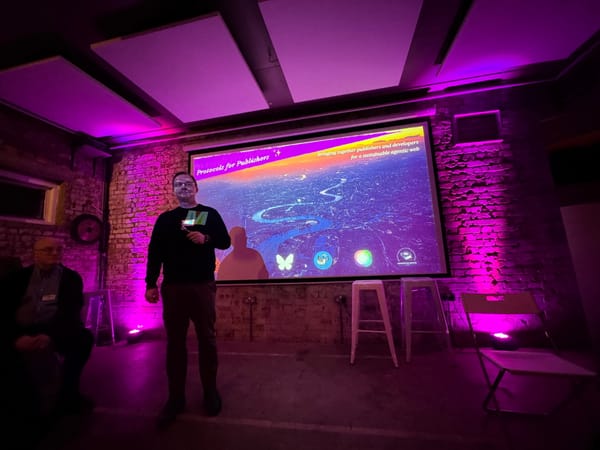
We are only one month out to our next in-person meeting in London. Speaker announcement!
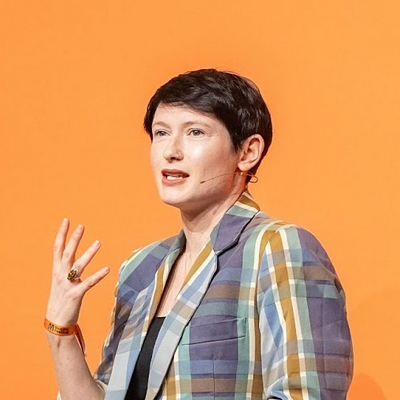
E.M. Lewis-Jong is the Founder and VP of Mozilla Data Collective—the community-led data platform for the ethical creation, curation, and control of AI training datasets. They are also the Director at Common Voice, the world’s largest open crowdsourced speech corpus, spanning 300+ languages and 750,000 open community contributors. EM has run AI community data programmes for the US National Science Foundation, NVIDIA, Gates Foundation, and GIZ. Before Mozilla, EM was a founding executive in CivTech: leading, launching and growing product from concept stage to venture-backed Series A. They are Sutton Trust Oxbridge Access Summer Schools Alumna, a Rising Star of Tech Awardee and a SheCodes Alumna. They sit on several multilingual AI advisory boards, including as NLP TAP Advisor for Google-backed Lacuna Fund, Industry Board Advisor for Speech Technologies at the University of Groningen and Data Advisor for the Caribbean Parliaments’ digitisation project. They studied at the University of Oxford, and are—in their spare time—a Doctoral researcher in AI Informatics, focussed on children, data and Intelligent Personal Assistants.
E.M. will be joining Saskia Welch (Newsmast) and Siddhartha Kurapati (Bristol Cable), as well as Aendra Rininsland (FT) on stage to present at the evening Showcase on February 4th. Read more on the PfP✨ London Event page where you can register for the Showcase and apply to participate in the day-long Stakeholder Forum on February 5th. The Forum has limited room and is filling up, so get your applications in. Looking forward to seeing you all! 👋
💬 Ideas from elsewere
Hacks/Hackers, The Atlantic’s product and tech team, and Infactory are running an event in East Palo Alto on Jan 31st to explore how AI can responsibly transform the news experience. Space limited to 100 and a $5k prize for top project. Link →
The community is converging on a standard schema (standard.site) for publishing long-form content on the AT Protocol (the decentralized network behind Bluesky). For web publishers like news sites this enables publishing on decentralized platforms while maintaining content portability: articles, metadata, and audience connections can move across different AT Protocol platforms without being locked into any single service. This is similar to how RSS enables syndication, but with richer metadata and better verification. Link →
The W3C's Technical Architecture Group and the Advisory Committee (TPAC) met in Kobe in Nov. Reviewing the meetings of TPAC, Heather Flanagan points out standards for web payments and digital identity are colliding. "Payments folks are realizing that credentials matter. Identity folks are realizing that wallets aren’t just for government IDs. Browser vendors are trying to build something usable without getting caught in regulatory crossfire. And everyone is trying to figure out how to handle AI before AI handles them." Link →
Two pieces from PfP✨NYC alums about the Future of News™️: Ben Werdmuller writes about the death of the article:
The written article — linear, static, and designed for a broad audience — was optimized for a world of scarce publishing space and shared attention. That world is disappearing. Referral traffic is collapsing. Homepages matter less than they once did. Increasingly, people encounter journalism through feeds, summaries, notifications, and recommendations shaped to their individual context.
He then explores what LLM-powered personalization might look like, and how it changes how we think about an "article" published on the web Link →
Next up is Patrick Boehler, who makes an important distinction between the journalism industry with the craft: "The industry is still using 20th-century credentials to measure 21st-century information utility." Link →
One more from Patrick: reporting from the AI and Journalism Summit organized by the Brown Institute for Media Innovation: "AI licensing is a stopgap, not a media strategy". A lot of banger quotes in that piece. Link →