Democracy, news tech, and the future of Canadian journalism: 3 event reports
From Toronto, London, and Vancouver.

DemocracyXchange
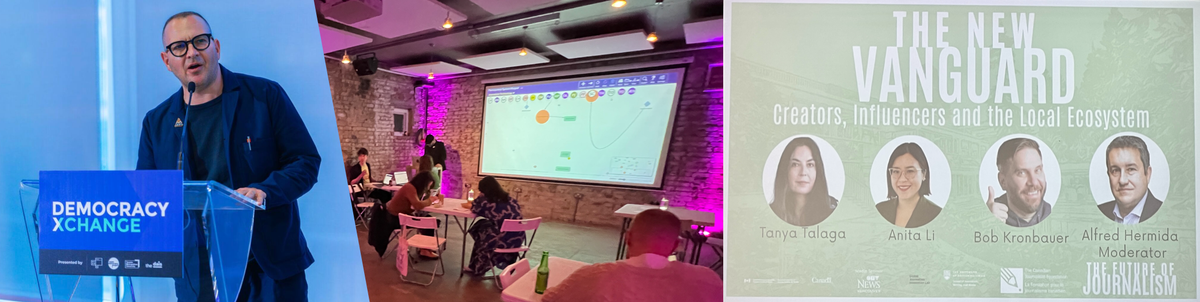
After leaving the AIPREF meeting on Thursday afternoon (see previous newsletter), we moved locations to OCAD University to hear Cory Doctorow give the keynote for DemocracyXchange, Canada's annual democracy summit. PfP✨ was invited to participate in a side event on media provenance organized by the Cultural Policy Hub at OCAD University. Earlier in the week was The International Press Telecommunications Council (IPTC) Media Provenance Summit in Toronto:
 Brendan Quinn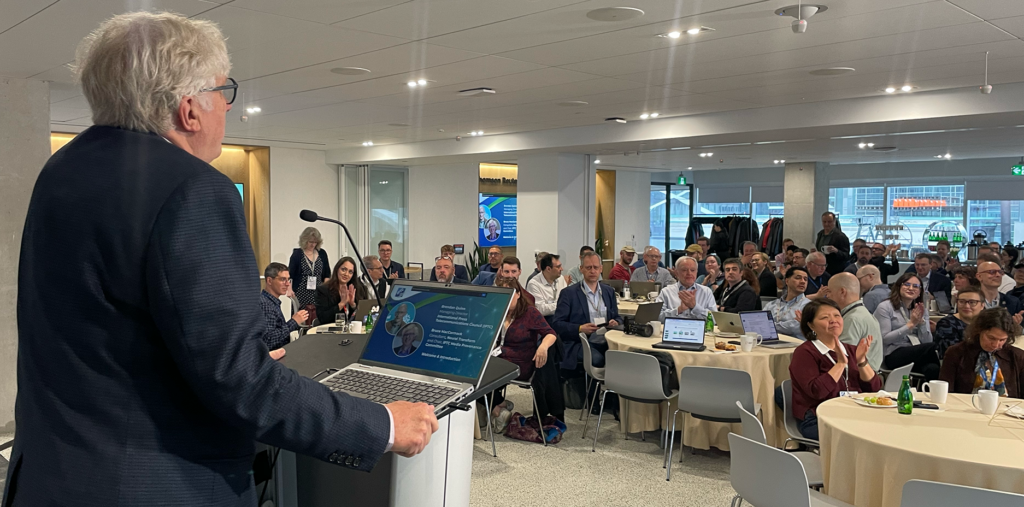
The IPTC has been actively driving adoption of the Coalition for Content Provenance and Authenticity (C2PA)'s standard (called Content Credentials) in the news industry. The protocol embeds a cryptographically signed manifest inside a media file which records how the content was created and every meaningful edit since capture, including which tools were used (and if AI was used). Tampering with the manifest is immediately detectable. C2PA is one of the technologies providing a cryptographically secure chain of custody to preserve "glass-to-glass" (ie. from camera lens to smartphone screen) integrity for a piece of content.
At the DXC Media Provenance workshop IPTC and C2PA members mixed with members of Canadian media, arts, and technology communities with the goal to explore what a voluntary Canadian Platform Code of Practice on Media Provenance would look like, and how to get there. The workshop featured a number of breakouts to assess the threat landscape across the information supply chain (ie deepfakes, AI journalists, disinfo amplification, etc), the various approaches to media provenance adoption (ie a Code of Practice or a Voluntary Framework, and what the ecosystem and technical challenges to adoption could be.)
The meeting was under Chatham House rules, but when a public report is released we will link to it in the future.
Journalism Technology London Meetup
After back-to-back events in Toronto Chad Kohalyk gave a short talk at the Journalism Technology London Meetup at Newspeak House (London's independent College of Political Technology). The Journalism Technology London Meetup is a bi-monthly gathering of journalists, technologists, and technical journalists. At this April event the group spent time networking and collaborating on a map of the journalism technology ecosystem, a living document that the group intends to grow over time (and possibly someday publish). The initial version of the map already provided value in understanding the ecosystem, the relationships between some of its parts, and where centers of power lie.
During the event Chad spoke to the group about what PfP✨ is doing to move protocol-based publishing ahead, giving examples such as participating in standards meetings, building a community of practice, and of course hosting PfP✨ events where action items and use cases can be harvested and shared with various protocol developer communities.
Future of Canadian Journalism
We return to Vancouver where the Canadian Journalism Foundation put on an event at the University of British Columbia called The Future of Journalism Summit featuring some big names in Canadian news including broadcasters, print media, and independent creators. The event was a mix of breakout discussions over lunch and more traditional panels.
The AI table — anchored by Advisor of AI Projects at CBC Rignam Wangkhang, founder of Canada’s National Observer Linda Solomon-Wood, and UBC School of Journalism, Writing, and Media professor Alfred Hermida — was very popular with discussion ranging from how AI can be used to raise civic awareness with apps like Civic Searchlight to its use in the classroom teaching journalism students. The experience of sitting around a table with a meal and hearing different publishers talk about how they are using AI, what worries them, and what they would like see in the future was very much like a mini Protocols for Publishers event. But two hours is not enough considering the breadth of the topic.
Independent news creators was another table discussion, further featured in a panel with BC Bob, Tanya Talaga, and Anita Li from The Green Line, a hyper-local “community information service” in Toronto. Canada seems to be following the trend of growing the news creator economy, but with so many other topics we did not have enough time to critically engage with the problems of celebrity culture or exploitation of para-social relationships during a loneliness epidemic. That and the word "Substack" was being thrown around in an uncritical manner. ☹️
Natalie Turvey, executive director of The Canadian Journalism Foundation gave a rundown the CJF's recent report on Canada's New News Mix which breaks down how independent news is affecting the wider ecosystem in Canada. A few tidbits from that report:
- 31% of Canadian adults say they get news from at least one independent news creator channel tested in the survey
- 75% of independent-creator users agree that independent creators are becoming more important in Canada’s news landscape, versus 53% of Canadians overall
- Across the full population, TV remains the single most common daily source at 52%, followed by:
- general social media 37%
- radio 32%
- news websites or apps from traditional outlets 31%
- daily newspapers 24%
- 72% of independent-creator users – and 70% of Canadians overall – agree that independent creators should be held to the same standards and regulations as traditional media.
🗓️ More Event news
PublicSpaces Conference is happening June 4-6 in Amsterdam where New_ Public, PublicSpaces and Waag Futurelab will be presenting the inaugural Open Social Awards. https://conference.publicspaces.net/en
"While FediForum started as an unconference that mainly attracted people already active in the fediverse space, that there is now space to have talks by MEPs, as well as talks about atproto shows that FediForum has expanded." Laurens Hof writes up Fediform https://connectedplaces.online/reports/fr161-conference-edition/
A roundup of reflection on the Hacks/Hackers AI x Journalism Summit https://www.hackshackers.com/ai-x-journalism-summit-takeaways-the-room-wasnt-sad-it-was-ready/
💱 A question of money
Gina Chua cautions against newsrooms chasing revenue strategies to keep the lights on while quietly abandoning the communities they exist to serve. https://restructurednews.substack.com/p/the-mission-of-money
Nick Thompson from The Atlantic spoke with Sam Altman of OpenAI on micropayments for AI agents, but there were not a lot of details. https://www.niemanlab.org/2026/05/sam-altman-backs-micropayment-model-for-ai-agents-to-compensate-publishers/
🔍 Google news
Google presented an overhauled AI-powered search that gets rid of the proverbial Ten Blue Links convention which we all know — and admittedly has not been around for quite a while. Hashtag GoogleZero is being posted from inside the house. https://techcrunch.com/2026/05/19/google-search-as-you-know-it-is-over/
Google also released a guide to optimize for generative AI search. In short, "the best practices for SEO continue to be relevant" https://developers.google.com/search/docs/fundamentals/ai-optimization-guide
🦋 🤖 AI preferences on atproto
AI Prefs are not just transmitted at the networking level. Last year Bluesky PBC released an initial proposal for handling User Intents for Data Reuse.
In response to that Blaine Cook posited a descriptive framework, rather than a prescriptive framework, as part of his project mapping different intent frameworks including the IETF's AIPREF. (Also see this follow-up on "Machine-readable attitudes")
Nick Gerakines also weighed in with an example lexicon for Signaling AI Preferences on ATProto